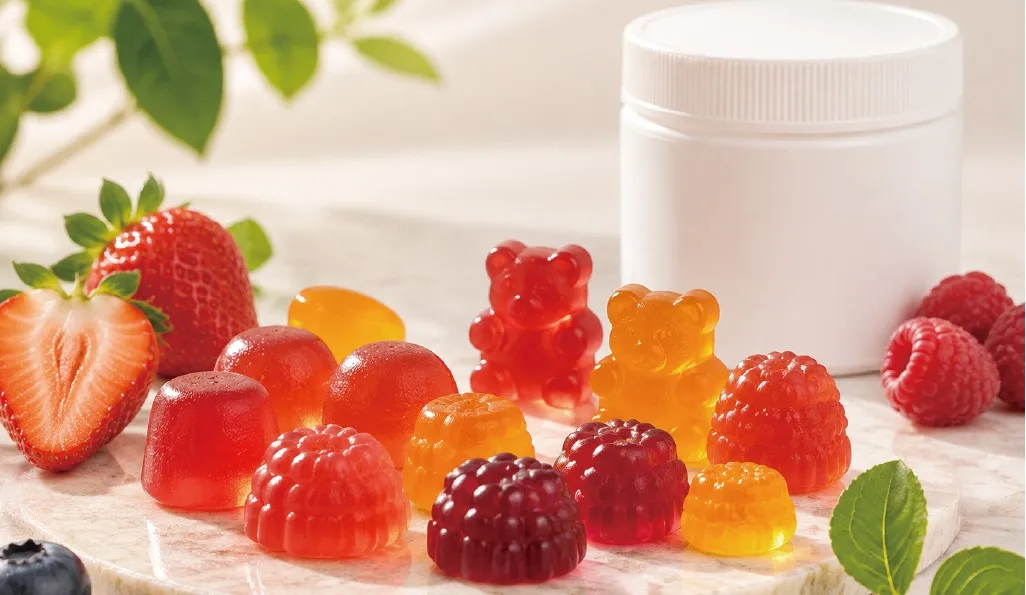
Core Engineering Thresholds for Cross-Border Gummy Transit
- Thermal Resilience: Citrus pectin maintains structural elasticity beyond 45°C (113°F), compared to gelatin which liquefies at 32°C (90°F).
- Critical Water Activity: Final product Aw must calibrate strictly below 0.60 Aw to arrest sugar sweating and microbial growth without sorbate preservatives.
- Dynamic In-Line pH Buffering: Lock deposit syrup pH at 3.25–3.40 via continuous sodium citrate metering to prevent active degradation.
- Freight Optimization: Eliminates the mandatory $2,500–$4,000 refrigerated reefer container surcharge on trans-Pacific and Middle East trade lanes.
1. The Commercial Reality: Ocean Freight Temperatures Routinely Exceed 38°C
For international dietary supplement brands exporting from manufacturing hubs to distribution hubs in North America, Europe, the Middle East, and Southeast Asia, gummy deformation in transit is the single largest source of retail customer chargebacks, Amazon FBA warehouse rejections, and inventory write-downs.
Standard uninsulated dry shipping containers sitting on vessel decks or awaiting customs clearance at transshipment ports (such as Jebel Ali, Singapore, or the Panama Canal) experience solar radiant heating that drives internal temperatures to 38°C–42°C (100°F–108°F) with relative humidity spikes above 85%.
When formulated with standard porcine or bovine gelatin, gummies will invariably soften, fuse together into a singular un-dispensable mass, and adhere permanently to PET bottle walls. This failure does not stem from defective packaging—it is an unavoidable thermodynamic limitation of the gelatin protein matrix.
2. Molecular Mechanics: Why Gelatin Fails Above 32°C While High-Methoxyl Pectin Thrives
To understand why pectin guarantees thermal survival, we must examine the intermolecular forces governing each hydrocolloid:
Gelatin relies on non-covalent triple-helix hydrogen bonding. These bonds are inherently thermo-reversible: at 32°C–35°C, thermal kinetic energy overcomes hydrogen bonds, returning the gel to liquid solution. Once cooled, the gummies re-solidify as a deformed block.
High-methoxyl (HM) citrus pectin forms an irreversible junction zone stabilized by hydrophobic ester methyl interactions and divalent cation (calcium) ionic bridging. This covalent-like network remains dimensionally stable beyond 45°C–48°C.
3. Technical Comparison Table: Pectin vs. Gelatin vs. Pectin-Agar Hybrid
Data generated from Konnor Formulation Laboratory trials across 100 industrial pilot lots (2025–2026 data):
| Formulation Parameter | 100% Citrus Pectin | Porcine/Bovine Gelatin | Pectin + Agar Hybrid |
|---|---|---|---|
| Thermal Melting Point | > 45°C (113°F) | 32°C – 35°C (Melts in transit) | > 48°C (Extreme heat) |
| Cross-Border Reefer Freight Needed? | No (Standard Dry Container) | Yes ($2,500+ extra fee) | No |
| Water Activity Critical Limit | Aw < 0.60 | Aw 0.65 – 0.72 | Aw < 0.58 |
| Deposit pH Window | 3.25 – 3.40 (Buffered) | 3.00 – 3.80 (Wide) | 3.30 – 3.50 |
| Religious / Dietary Status | 100% Vegan, Halal & Kosher | Non-Vegan, Halal cert required | 100% Vegan & Halal |
| Texture & Sensory Chew | Clean, crisp, short bite | Rubbery, elastic, chewy | Firm, jelly-like structure |
| High-Load Active Compatibility | High (Up to 1500mg Creatine) | Moderate (Gelling weakens) | Very High |
4. The Water Activity (Aw < 0.60) Protocol: Stopping Sugar Sweating & Inversion
Many brand founders erroneously evaluate gummy dryness purely by total moisture percentage (typically targeting 12%–16%). In cGMP stability engineering, water activity (Aw) is the sole governing thermodynamic parameter.
Water activity measures the energy state of unbound free water in the matrix. When Aw exceeds 0.65, free water vapor migrates outward toward the gummy boundary, dissolving surface citric acid crystals and sucrose granules. This phenomenon—commonly known as sugar sweating or syneresis—creates a wet, sticky syrup film on the surface that promotes bottle clumping and establishes an environment where osmophilic molds can proliferate.
Following starchless mold deposition at 80°–82° Brix, Konnor passes gummies through 36-hour continuous multi-stage dehydration tunnels maintained at 20°C–22°C and 30%–35% Relative Humidity. Final lot QA tests using calibrated chilled-mirror dewpoint water activity meters certify that every bottle leaves the cleanroom with Aw strictly between 0.52 and 0.58.
5. In-Line pH Buffering: Maximizing Gel Shear Strength Without Active Hydrolysis
Citrus pectin requires an acid trigger to establish its gel network: carboxyl groups must be protonated to reduce negative electrostatic repulsion, allowing polymer chains to aggregate into junction zones.
However, if bulk syrup pH drops below 3.20 too early during high-temperature cooking, pre-gelation occurs in the depositor nozzles, causing stringing and uneven piece weights. Conversely, sensitive active botanicals (such as Ashwagandha withanolides or Melatonin) suffer hydrolytic breakdown under prolonged acid exposure.
Konnor resolves this dilemma using dynamic split-stream inline acid injection: the pectin syrup is held at neutral pH 3.8–4.0 during primary vacuum cooking, and food-grade buffered sodium citrate / citric acid solution is metered into the manifold only seconds prior to depositor nozzle discharge, locking final piece pH securely at 3.32 ± 0.05.
6. Surface Finishing: Carnauba Oil Micro-Polishing vs. Acid Sanding
Final surface conditioning determines whether gummies remain free-flowing after 18 months on retail shelves:
- Micro-Fine Carnauba Polish: Applying food-grade refined carnauba wax with fractionated coconut MCT oil in automated rotating tumbling drums creates a hydrophobic protective lipid barrier that prevents moisture re-absorption.
- Micro-Encapsulated Acid Sanding: For sour fruit SKUs, standard malic acid quickly pulls ambient moisture from the air. We utilize lipid-encapsulated malic acid crystals that preserve intense sour tartness on the palate while preventing hygroscopic melt.
Contract Manufacturing & Formulation Services
Turnkey Pectin Gummy Manufacturing Lines →
Starchless automated deposit lines producing up to 300,000 gummies daily. Pectin, sugar-free polyols, and custom 3D CNC molds.
Sleep & Night Relaxation Formulations →
Explore market-proven pectin sleep chews with Melatonin, Tart Cherry, Magnesium Glycinate, and L-Theanine.
Planning a Summer or Cross-Border Gummy Launch?
Connect directly with our senior formulation chemists on WhatsApp to review active ingredient load limits, run simulated thermal stress chamber trials, or evaluate our commercial pilot sampling kit.